
I previously posted a black and white version of a map depicting the land allotment for Israel in Joshua, but I think the color version is easier to read. I hope this is helpful!

I previously posted a black and white version of a map depicting the land allotment for Israel in Joshua, but I think the color version is easier to read. I hope this is helpful!
Jesus, immediately after claiming that he came not to abolish, but fulfill the law of Moses, proceeded to make what seems to be pretty major alterations to the law in Matthew 5-6. What did he mean by claiming to “fulfill” the law, and how should we understand his teaching about the things that were told to the Israelites of old?
(Preaching on the law of Moses. This sermon was preached at the Dewey Church of Christ on March 2, 2025.)

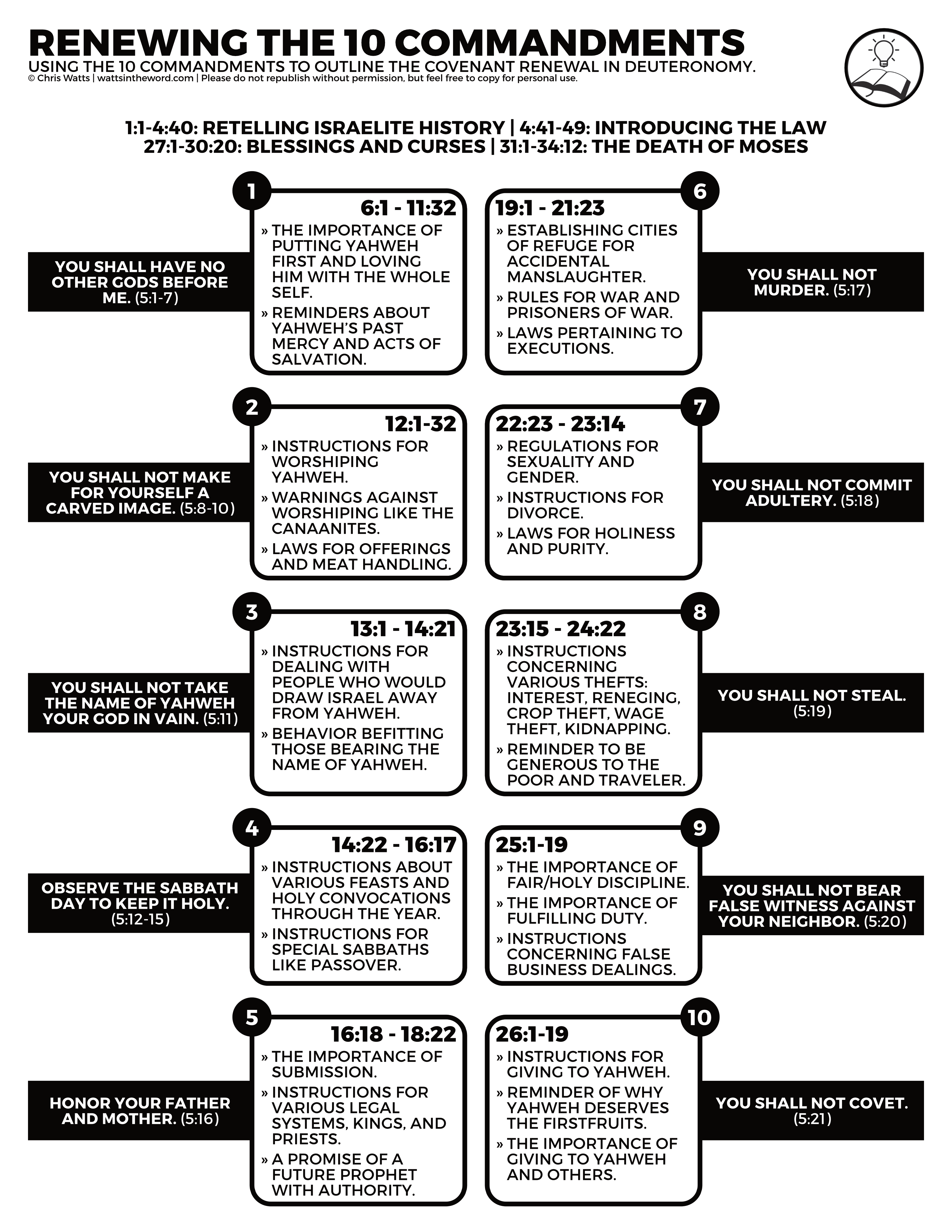
Deuteronomy, in addition to being a summary and recap of the law given through Moses, serves as Moses’s farewell address to Israel. At the end of his life, Moses was predominantly concerned with how Israel would keep God’s covenant after he was gone. Deuteronomy contains his admonition and encouragement for Israel to keep the covenant. What can we learn from his instruction to Israel for our own efforts to keep covenant with God?
(Preaching through the Pentateuch. This sermon was preached at the Dewey Church of Christ on March 2, 2025.)
As we transition into a new phase of the story in our journey through the Bible in 2025, it might be helpful to be able to visualize the land of Israel. Here is an overview chart for Deuteronomy, as well as a map of the land allotment for the Israelites given to them by Joshua.


While there certainly are a lot of numbers in the book of Numbers, a better title for the book might be the Jewish one: In the Desert. The narrative sections focus on Israel’s struggles to obey the Law they had just received through Moses, and their journeys in the desert as a result. But our struggle to obey God mirrors theirs; we have the same heart problems and motivational issues as they did. What can we learn from their struggles in the desert?
(Preaching on Numbers. This sermon was preached at the Dewey Church of Christ on February 23, 2025.)
This is the second part of our consideration of how the modern Christian should relate to the law of Moses. If there is so much difference between the laws of Moses and Christ, why was the law of Moses given at all? If Christ was always the plan, why didn’t God just jump straight to Jesus?
(Preaching on the law of Moses. This sermon was preached at the Dewey Church of Christ on February 16, 2025.)
It’s important that modern Christians do not neglect a study of the Law of Moses, for in it we learn much about the character and nature of the God we serve. What can we learn about God from a study of Leviticus, and how should such a study affect us today?
(Preaching through the Law of Moses. This sermon was preached at the Dewey Church of Christ on February 16, 2025.)
I am a bit late with this chart in our read through the Bible at Dewey this year. As a reminder, there won’t be a chart like this for every book, but I hope this is helpful for you.


Inevitably as a person reads through the Law of Moses in Exodus-Deuteronomy, the many, many differences between that law and what would later come through Jesus and his apostles become glaring. How can we explain and understand the differences between God’s expectations for the Israelites, and his expectations of his people today? And why do the differences matter?
(Preaching on the law of Moses. This sermon was preached at the Dewey Church of Christ on February 9, 2025.)
While there are literally hundreds of laws in the Law of Moses, the first ten are called out as especially significant. What makes them so special, and how have they continually resonated with God’s people over the course of millennia?
(Preaching on the Law of Moses. This sermon was preached at the Dewey Church of Christ on February 9, 2025.)
 Watts in the Word
