
I am a bit late with this chart in our read through the Bible at Dewey this year. As a reminder, there won’t be a chart like this for every book, but I hope this is helpful for you.

I am a bit late with this chart in our read through the Bible at Dewey this year. As a reminder, there won’t be a chart like this for every book, but I hope this is helpful for you.

Inevitably as a person reads through the Law of Moses in Exodus-Deuteronomy, the many, many differences between that law and what would later come through Jesus and his apostles become glaring. How can we explain and understand the differences between God’s expectations for the Israelites, and his expectations of his people today? And why do the differences matter?
(Preaching on the law of Moses. This sermon was preached at the Dewey Church of Christ on February 9, 2025.)

While there are literally hundreds of laws in the Law of Moses, the first ten are called out as especially significant. What makes them so special, and how have they continually resonated with God’s people over the course of millennia?
(Preaching on the Law of Moses. This sermon was preached at the Dewey Church of Christ on February 9, 2025.)

In our journey through the story of the Bible we have come to Exodus. The first half of the book is God’s grand revealing of his name, character, and power – not just to the Israelites, but to the world. In this revealing, God establishes patterns that will reoccur throughout the rest of the Bible story. What are these patterns, and what do we learn about him in the Exodus?
(Preaching through the story of the Bible. This sermon was preached at the Dewey Church of Christ on February 2, 2025.)
The second in our two-part lesson on the problem of pain approaches the problem in a more traditional, critical way: given the nature of God, his power, love, and knowledge, how can evil and suffering still exist?
(Preaching on the problem of evil. This sermon was preached at the Dewey Church of Christ on January 26, 2025.)

This is the first of a two-part lesson on the problem of suffering and pain in the world. This first part comes from Job: what can we learn about suffering and the problem of pain in our lives from Job and his discussion with his friends?
(Preaching on Job. This sermon was preached at the Dewey Church of Christ on January 26, 2025.)
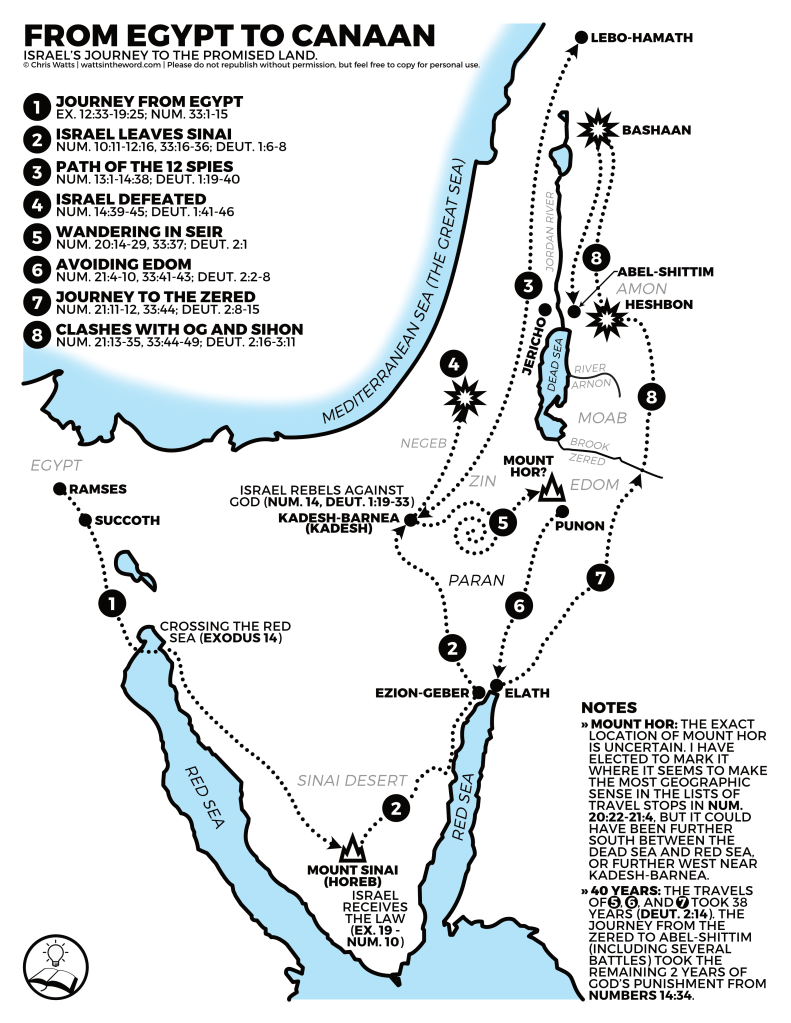
Here are the next in the series of supplemental materials for our journey through the story of the Bible: a map of Israel’s journey from Egypt to Canaan, and an overview of the book of Exodus.
Here are the pngs, if you prefer.


The story of Joseph is at the heart of a lot of Yahweh’s providential work in Genesis and Exodus. How did God work to bring Joseph into a position of influence, and what did God accomplish by doing so.
(Preaching through Genesis. This sermon was preached at the Dewey Church of Christ on January 19, 2025.)

As we begin our journey through the Bible, it might be helpful to consider some broad ideas about the Bible: it’s composition, structure, themes, and genres. How can we become more “acquainted with the sacred writings” (2 Timothy 3:15)?
(Preaching through the story of the Bible. This sermon was preached at the Dewey Church of Christ on January 12, 2025.)

The grouping of Abraham, Isaac, and Jacob appears around 20 times throughout the Bible, often called “the fathers.” As we read through their stories in Genesis, what made them the kind of people God could use to put his great plan of redemption into motion?
(Preaching through the story of the Bible. This sermon was preached at the Dewey Church of Christ on January 12, 2025.)


