The Culmination of Prophecy

Matthew’s gospel is the most closely connected to the Israelite story in the Old Testament. He connects these stories in two main ways: the fulfillment of prophecy, and the continuation of the kingdom. First, we will consider how Matthew addresses prophecy in the life of Jesus. How does Jesus fulfill all the promises of God in the Old Testament, and what does it mean for the modern reader?

Click Here to Listen.

(Preaching on the gospels. This sermon was preached at the Dewey Church of Christ on October 5, 2025.)

The Kingdom Promises

In addition to a heavy emphasis on Old Testament prophecy, Matthew also keys in on the idea of the “Kingdom.” This is an extension of two foundational Old Testament promises, one to Abraham and one to David. While Matthew really highlights Jesus’s teaching about what his new kingdom will be like, the New Testament writers as a whole connect Jesus to these ancient promises and emphasize that the kingdom of Jesus is the culmination of God’s redemptive work.

Prophecy in Matthew

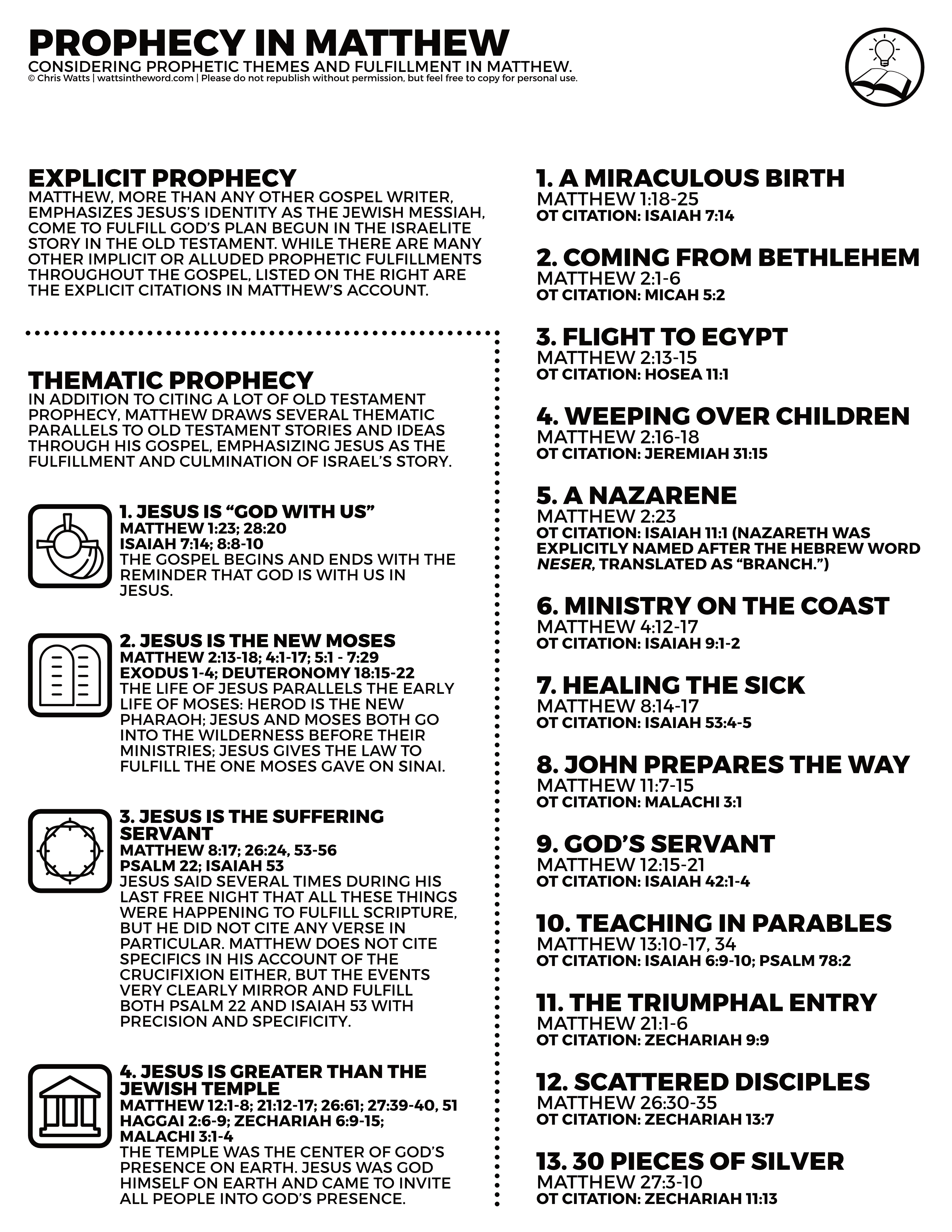
Matthew focuses on the Jesus the Jew more than the other gospel writers, especially in the way that Jesus is the culmination of so much Old Testament Hebrew prophecy. While Jesus fulfills more prophecy than just the ones listed on this chart, these are some of the most explicit references in Matthew, along with some overarching prophetic themes.

God With Us

We begin our foray into the New Testament with the Gospel of John; not the first gospel in most English Bibles, but the one that most closely parallels the beginning of the Bible in Genesis. What is different about John’s version of Jesus’s story, and what does he emphasize more than the other authors?

Click Here to Listen.

(Preaching on the gospel. This sermon was preached at the Dewey Church of Christ on September 28, 2025.)

The Common Gospel

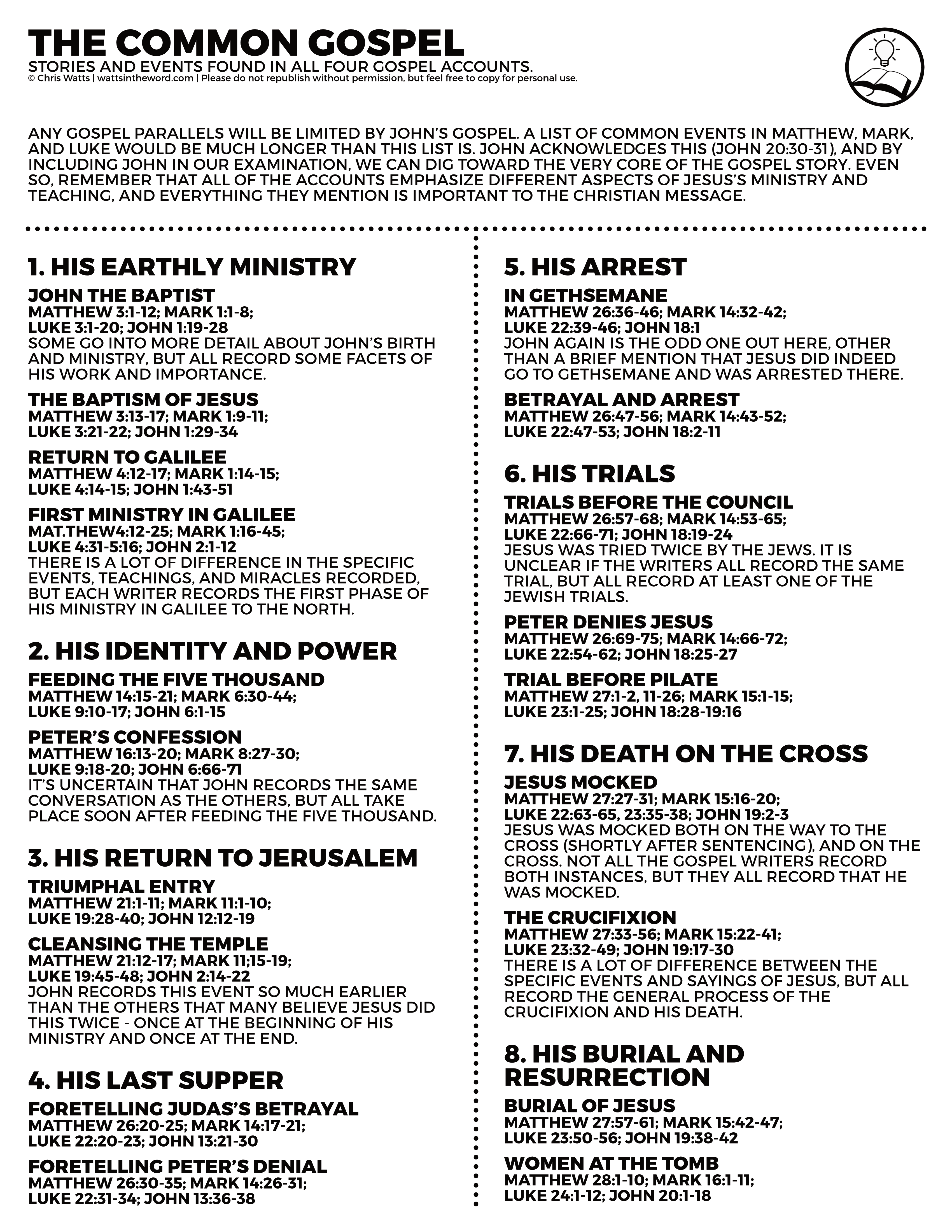
Any Gospel parallels will be limited by John’s Gospel. A list of events common to Matthew, Mark, and Luke would be much longer than the following list. John acknowledges this (John 20:30-31), and by including John in our examination, we can dig toward the very core of the Gospel story. Even so, remember that everything mentioned by any of the gospels is important to the Christian message.

The Coming Messiah

For a word that carries such importance in modern Christianity, the word “Messiah” appears astonishingly little in the Bible. Why is that? Aside from the quirks of translations and transliterations, why is this such an important prophetic title, and how did the intertestamental Israelites begin to think about it, leading to the arrival of Jesus?

Click Here to Listen.

(Preaching on the intertestamental period. This sermon was preached at the Dewey Church of Christ on September 21, 2025.)

Intertestamental Prophecy

While there are no narrative parts of the Bible that describe the 400 years between Nehemiah and Jesus, the Bible is not silent about that era of history; Daniel had a string of visions describing that time. How do Daniel’s visions guide us through this era and bring us to the arrival of the “Son of Man”?

Click Here to Listen.

(Preaching on the intertestamental period. This sermon was preached at the Dewey Church of Christ on September 14, 2025.)

God is in Control!

As we wrap up our reading through the Old Testament with 2 Chronicles, it is important to consider if God still interacts with the world, nations, and geopolitics today in the same way that the Chronicler emphasizes. Even though God isn’t as explicit or clear with us today in how he is working, how can we be confident of his sovereignty in the world today?

Click Here to Listen.

(Preaching through Chronicles. This sermon was preached at the Dewey Church of Christ on September 14, 2025.)

The Purpose of Existence

The turn from 1 to 2 Chronicles focuses on David’s and Solomon’s efforts in building the temple, but during this process both David and Solomon recognize a puzzling aspect to their work; God doesn’t actually need a temple, everything that they used to build it came from him, and a temple can’t contain him anyway. So why build the temple? This question is a microcosm of a much larger question: why did God create anything at all? What is the point of our existence? David’s and Solomon’s prayers provide a good foundation from which to explore this deep question.

Click Here to Listen.

(Preaching through Chronicles. This sermon was preached at the Dewey Church of Christ on September 7, 2025.)